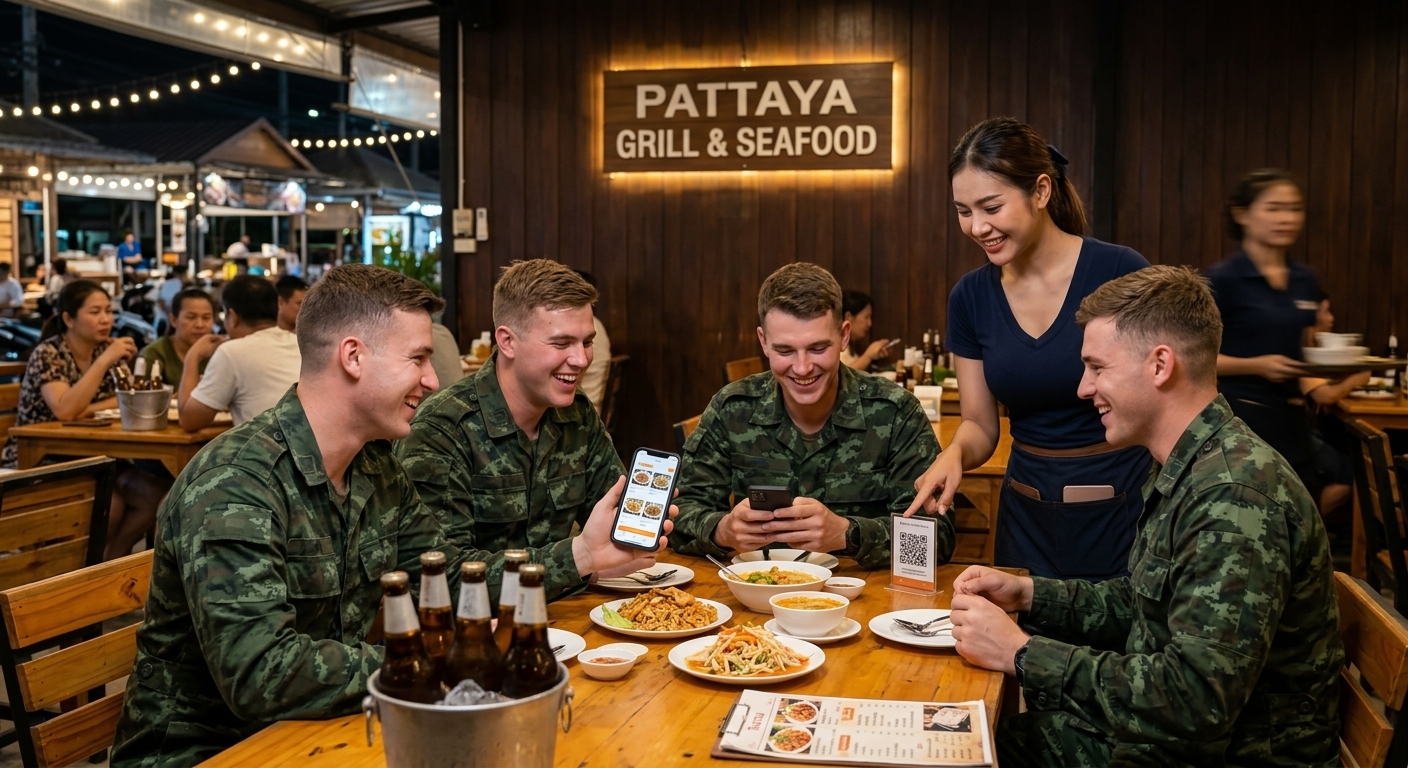
If your restaurant or bar is in Pattaya, Jomtien, Naklua, Sriracha or anywhere near Laem Chabang, the period from 2 to 6 September 2026 is the biggest single block of foreign customers your venue will see in months.
Thailand Ministry of Defence spokesman, Rear Admiral Surasant Kongsiri, announced in late August 2026 that the aircraft carrier USS Abraham Lincoln, accompanied by two escort vessels, would berth at Laem Chabang port from 2 to 6 September 2026 with roughly 5,000 personnel on board. The Ministry was explicit that this is a rest-and-resupply port call, not a joint military exercise with Thai forces. This crew has been at sea for more than 200 days without a full shore leave, and Laem Chabang sits about 30 km from Pattaya.
Thai media put the local spending impact at somewhere between 5 and 15 million baht - worth repeating that this is an estimate, not a recorded figure. The Governor of Chonburi has held a readiness meeting and reminded operators not to overcharge visitors.
This article is not here to get you excited about the number 5,000.
Because if you are a foreign owner in Pattaya, you already solved the obvious problem years ago. Your menu is in English. Some of it is in three languages. You are not the guy handing a Thai-only menu to a tourist.
The gap is somewhere else, and it is quieter.
Your menu is in English. Your kitchen ticket is not.
Here is the chain an order actually travels through in a foreign-owned venue in Pattaya on a busy night.
The guest reads your English menu and asks a question in English. Your server - often 19 or 20, with maybe forty words of English and too shy to try the forty-first - understands part of it. She writes the order down in Thai. The kitchen reads her Thai handwriting and cooks from that.
That is three translations between the guest and the pan. Nobody in that chain is doing anything wrong. It is just that every link loses a little.
And there is one person in the building who could fix any of it on the spot: you. You speak both sides. Which is exactly the problem - because on a Friday at 8pm you are behind the bar, or on the till, or arguing with a supplier on the phone. You cannot be at table nine explaining what shrimp paste is.
So ask yourself the question that actually matters: what happens on your day off?
If the honest answer is that things get simpler and cheaper - meaning guests order less, ask nothing and leave early - then you are not running a venue that serves foreign guests. You are personally serving them, and the venue borrows your ability whenever you happen to be standing there.
2-6 September 2026 is an exam you did not choose to sit
Picture it.
Six sailors walk in on a Friday. The place is full, the kitchen is slammed. Your server hands over the menu - English, decent photos, fair prices. Then the questions start.
What is actually in this one?
Is it spicy? How spicy?
Does this have pork in it?
Is there peanut in the dipping sauce? My mate is allergic.
How many people does this feed?
Is it spicy? How spicy?
Does this have pork in it?
Is there peanut in the dipping sauce? My mate is allergic.
How many people does this feed?
Every one of those is a reasonable question. Not one of them is answered by a photograph, and not one of them is going to be answered by a shy 19-year-old across a wall of kitchen noise.
So the table does what every foreign table does when asking gets hard. They stop asking, they point at the three safest-looking items on the page, they order one beer each because they do not know what else you have, they eat in 25 minutes and they leave.
That bill is not wrong. It is just not full. It might be half of what that table was ready to spend.
And here is the part that makes it dangerous: nobody complains. They smile, they pay, they say the food was great, they walk out. You will never know what that night cost you, because losses like this leave no trace anywhere in your reports.
Just put more photos on the menu - why that is not enough
This is the advice every owner in Thailand hears. Photos on everything, let them point.
Photos genuinely help. But a photo answers exactly one question: what does it look like?
A photo cannot answer what is in it.
• A photo of green curry does not say whether it contains shrimp paste or fish sauce - so the vegetarian at the table will not risk it.
• A photo of seafood dipping sauce does not say whether there is ground peanut in it - so the guest with the allergy avoids the whole dish.
• A photo of a spicy salad does not say how spicy - so the guest who cannot take heat skips the entire section.
• A photo of fried rice does not say whether there is pork in it - so your Muslim guests cannot order it.
• A photo does not say how many people a dish feeds - so a group of six under-orders, because nobody wants to be the one who wasted food.
• A photo of seafood dipping sauce does not say whether there is ground peanut in it - so the guest with the allergy avoids the whole dish.
• A photo of a spicy salad does not say how spicy - so the guest who cannot take heat skips the entire section.
• A photo of fried rice does not say whether there is pork in it - so your Muslim guests cannot order it.
• A photo does not say how many people a dish feeds - so a group of six under-orders, because nobody wants to be the one who wasted food.
Notice that every single one of those ends in the same decision: I will just get something safe. And the safest thing on any menu is almost always one of the cheapest.
Photos let people point. Photos do not make people brave enough to order the expensive thing. What makes them brave is a description they can read, in the language they think in.
The two costs that never show up on the bill
Cost one: the orders that came out wrong.
Something got lost between the table and the pan. The dish goes back, gets remade, food goes in the bin, and it eats kitchen time at the exact moment the kitchen has none. You can see this cost, because it hurts immediately. Venues that switch to guests scanning and ordering themselves through eMenu see wrong orders drop by around 31% - because the order goes into the system straight from the guest own hand, with no listening, no handwriting and no translating in between.
Cost two: the orders that never happened.
The guest who wanted a starter, a second round, a dessert - and did not order it, because asking was too much work. This cost appears in no report anywhere. No receipt, no complaint, no waste.
You see the first one. You never see the second one. And the second one is much bigger.
The one moment you can upsell without saying a word
This is the part most owners overlook completely.
When a guest opens the menu on their own phone, in their own language, they are not just able to read it - they are in the most deliberate, most receptive minute of the entire meal. That is the exact moment a system can do the job your staff physically cannot do at 8pm on a Friday.
• Guest orders crab fried rice, and the system offers tom yum goong alongside it, with an actual explanation of what it is
• Guest orders a main, and the system offers the high-margin add-ons: extra egg, extra meat, upsize
• Guest orders something spicy, and the system offers a cold drink and a dessert to finish
• Big table, and the system offers a set instead of separate dishes, which comes out higher and is easier for the kitchen
• Guest orders a main, and the system offers the high-margin add-ons: extra egg, extra meat, upsize
• Guest orders something spicy, and the system offers a cold drink and a dessert to finish
• Big table, and the system offers a set instead of separate dishes, which comes out higher and is easier for the kitchen
Your best server can only work one table at a time, and on a full night she has no time to work any of them. A system works every table simultaneously, in each guest own language.
There is a second effect nobody talks about: it removes the pressure. Plenty of foreign guests dislike being upsold by a person standing over the table, because saying no to someone face to face feels rude - so they default to no. When the same suggestion appears on their own screen, they can tap it or ignore it with nobody watching. More people tap it.
Venues using eMenu see average spend per bill rise by around 22%. Not from raising prices - from selling people things they already wanted and previously had no way of knowing existed.
What 10 languages actually means on a Friday in Pattaya
Two things happen at once, and they solve two different problems.
On the guest side: the QR menu runs in 10 languages. The guest scans, picks their own language on the first screen, and reads. There is no app to download and nothing to sign up for - which matters more than it sounds, because a tourist in town for four nights is never installing a restaurant app. (Russian is on our roadmap, not live yet - we would rather tell you that now than have you promise it to a guest.)
Pattaya is not an English-only town, and the week of a US port call is the exception, not the rule. On any normal Saturday your room holds guests who are not comfortable in English at all.
On your staff side: the POS runs in 11 languages. Your Thai team works in Thai. Your kitchen hand, your floor manager, the new server who reads Thai slowly - each works in the language they actually think in.
Put those two together and the chain from the start of this article simply disappears. The guest reads the menu in their language. The order lands in the system directly. Your kitchen reads it in Thai. Nobody in the middle has to translate anything, including you.
That is the real answer to the problem that your staff do not all speak English. You are not going to fix that with a training session, and you should not have to. The order should not need to pass through anybody English in the first place.
A 6-point self-test for your own venue (costs nothing, buy nothing)
Do this during 2-6 September 2026, or on any night your venue is busy with foreign guests. One sheet of paper, one pen.
1. Count the tables where a guest asked something and your staff could not answer. Just tally marks. One night.
2. Count the tables you personally had to walk over to and translate for. Then ask yourself what those tables look like on your day off.
3. Count how many foreign tables ordered a starter, a second drink round, or a dessert - and compare that with your Thai tables the same night.
4. Work out average spend per head, foreign tables versus Thai tables. If your foreign tables come out lower despite having more money to spend, you have found your answer and you did not need us to tell you.
5. Count how many of these five questions your menu answers on its own: Is it spicy? Does it have pork? Does it have peanut? Does it have seafood? How many people does it feed?
6. Count the dishes remade or sent back because something got lost in communication.
2. Count the tables you personally had to walk over to and translate for. Then ask yourself what those tables look like on your day off.
3. Count how many foreign tables ordered a starter, a second drink round, or a dessert - and compare that with your Thai tables the same night.
4. Work out average spend per head, foreign tables versus Thai tables. If your foreign tables come out lower despite having more money to spend, you have found your answer and you did not need us to tell you.
5. Count how many of these five questions your menu answers on its own: Is it spicy? Does it have pork? Does it have peanut? Does it have seafood? How many people does it feed?
6. Count the dishes remade or sent back because something got lost in communication.
Those six numbers are worth more to your venue than advice from anybody, including us - because they are your numbers, from your room, on your night.
If you want to fix it - and the part we would rather say straight
Straight up: setting up eMenu takes 3 to 5 days, including building your menu, setting prices and training your team. If you are reading this a few days before 2 September 2026 and hoping to have it running for the port call, we will tell you plainly: you will not make it. And we are not going to tell you otherwise to close a sale.
But that port call was never the last opportunity.
• This ship is not the last ship. Laem Chabang has handled port calls like this before, including another US Navy visit in March 2026.
• High season from November to February is many times bigger than a few days of shore leave, and it comes back every single year.
• Chonburi has foreign customers all year round. The communication problem does not arrive with the news and leave with it.
• High season from November to February is many times bigger than a few days of shore leave, and it comes back every single year.
• Chonburi has foreign customers all year round. The communication problem does not arrive with the news and leave with it.
What eMenu gives your venue:
• A QR menu in 10 languages - guest scans, picks their own language, no app, no signup
• A POS in 11 languages for the staff side, so your team works in the language they read best
• Recommendations, sets and add-ons at the moment of scanning, on every table at once, in the guest own language
• Membership, points and coupons included in the same package, nothing extra to buy
• Per-dish sales reporting, so you know what foreign guests actually order instead of guessing
• A support team available every day - not sold and abandoned
• A POS in 11 languages for the staff side, so your team works in the language they read best
• Recommendations, sets and add-ons at the moment of scanning, on every table at once, in the guest own language
• Membership, points and coupons included in the same package, nothing extra to buy
• Per-dish sales reporting, so you know what foreign guests actually order instead of guessing
• A support team available every day - not sold and abandoned
Cost: the BASIC package is 5,980 THB per year (excluding 7% VAT), roughly 16 baht a day. STANDARD is 9,990 THB per year (excluding 7% VAT), roughly 27 baht a day. Venues that want the full hardware kit can take the complete set at 18,999 THB.
There is also a 7-day free trial - give the team a phone number and they will set it up for you. We would honestly rather you test it against your own busiest night than take our word for anything in this article.
Set that against one foreign table on one Friday that ordered half of what it was willing to order, and the number answers itself.
Questions owners actually ask
Do my guests need to download an app?
No. They scan the QR code and the menu opens in their phone browser, with the language choice on the first screen. A tourist in town for a few nights will not install a restaurant app, and this point matters more than most owners expect.
How many languages does the system support?
The guest-facing QR menu supports 10 languages and the staff-facing POS supports 11. Guests choose their own language; your staff do not have to set it for them. Russian is on the roadmap and not live yet.
My staff barely read English - can they even use this?
Yes. That is the main reason the POS runs in 11 languages: your Thai team uses it in Thai, and staff who read another language better can switch to it. The point is that the order never has to pass through anyone second language, because the guest enters it themselves in theirs.
Do I have to translate my whole menu myself?
No. The eMenu team helps set up and structure the menu during installation, which is the 3 to 5 day window described above.
I run one small venue. Is it worth it?
It depends entirely on how many foreign guests you get. In Pattaya or another tourist zone with foreign guests every day, the difference in average bill usually covers the system quickly. If almost all your customers are Thai locals from the neighbourhood, multilingual is probably not the first thing to spend on, and we will say so.
Is there a free trial?
Yes - 7 days, free. Give the team a phone number and they will set it up for you. Seven days covers at least one full weekend, which is the only test that really means anything: whether your foreign tables order differently once they can read the menu themselves.
The bottom line
Between 2 and 6 September 2026 there will be thousands of foreign visitors walking around Chonburi. They will go into restaurants and bars, and they will spend.
The question was never whether they walk into your place. The question is how much of what they wanted they were actually able to order once they sat down.
If the answer is that they pointed at the photos, then the guests with the most money to spend in your room are ordering the cheapest things on your menu - and thanking you on the way out.
If you cannot fix it in time for that week, then write the numbers down and decide before the next high season.
Once you have got them, send them over. Message us with your venue name + province + number of branches + contact number + a good time to call, and tell us what actually happened on your busiest foreign-customer night.
We will look at your real numbers and tell you straight where to start - or, if your venue does not need to start yet, we will tell you that too.
Or add us on LINE → lin.ee/VNeUGxa