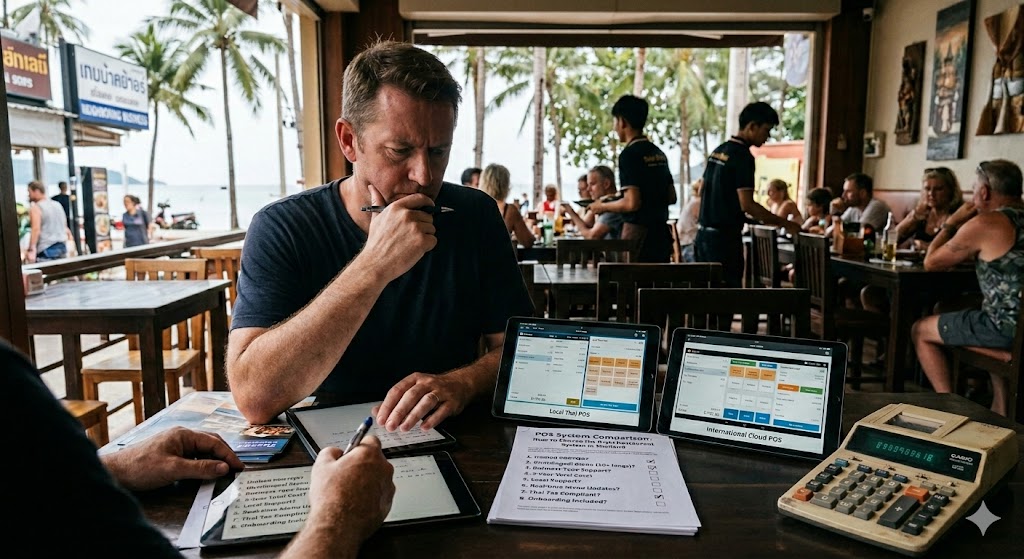
Choosing a POS system in Thailand is harder than it should be. The market is crowded with options — local Thai-market systems, regional Southeast Asia platforms, and international cloud POS providers — and each one is optimised for a different type of venue. For a restaurant in Bangkok serving mostly Thai customers, your priorities are completely different from a beachfront restaurant in Phuket serving Chinese tour groups, Japanese honeymooners, and European expats.
This guide breaks down what actually matters when comparing POS systems for restaurants, cafés, bars, and spas in Thailand — without naming brands. You can use it as a checklist when evaluating any system.
1. Does it integrate QR ordering with the POS, or are they separate?
The cheapest setups use a QR menu service from one provider plus a POS from another. They don't talk to each other — staff has to manually re-enter orders, errors creep in, and your sales report doesn't match your kitchen receipts. A unified POS + QR system (like eMenu Thailand) means an order scanned at the table appears instantly on the kitchen display, the cashier, and the daily report. No double entry.
2. How many languages does the QR menu actually support?
Many POS systems advertise "multilingual menu" but only ship with Thai + English. If you serve Chinese, Japanese, Korean, or European tourists, this matters enormously. eMenu Thailand's customer-facing QR menu supports 10 languages (English, Thai, Chinese Simplified, Chinese Traditional, Japanese, Korean, Italian, Spanish, Vietnamese, Portuguese), the POS adds French (11 total), and Russian is on the roadmap. Compare this against any system you're considering by asking specifically: "show me your guest-facing QR menu in Japanese."
3. What business types does the POS support?
Not all restaurants are sit-down restaurants. If you run a hot pot buffet, a beach bar, a spa, a KTV venue, or a beauty salon, you need a POS designed for that workflow — not a restaurant POS shoehorned into your business. eMenu Thailand supports 12 hospitality categories. Many alternatives only support standard restaurants and cafés.
4. How is pricing structured?
POS pricing in Thailand falls into three rough models:
— Monthly SaaS: low upfront, predictable monthly fee
— First-year package + annual subscription: higher upfront, lower year-2+ fee (eMenu Thailand uses this model, starting from 18,999 THB first year)
— Pay-once + extras: looks cheap but features get unlocked individually
Calculate total cost over 3 years before committing — the "cheapest" system in year 1 is often the most expensive long-term.
5. Where is the support team based?
A POS system breaks on a busy Saturday night. Who answers the phone? Is it a chatbot? A ticket queue? A call centre in Bangkok? An offshore office in another country? For tourist-area restaurants in Phuket, Krabi, Samui, or Khao Lak, local on-site support matters more than software features. eMenu Thailand's team is physically based in Thailand and supports in Thai, English, and Chinese.
6. How easy is it to update the menu?
When you mark an item sold out, change a price, or add a new dish — does the change appear immediately across every QR code and POS terminal? Or does it require a manual sync? Real-time menu updates from a phone are now table stakes. If a system requires you to "refresh" terminals individually, walk away.
7. Does it handle Thai tax receipts and split bills properly?
This sounds basic but many international POS systems handle Thai VAT receipts poorly. Make sure the system can:
— Print proper Thai tax-compliant receipts (ใบกำกับภาษีอย่างย่อ)
— Handle split bills by guest, item, or amount
— Process common Thai payment methods (cash, transfer, credit/debit, e-wallets, PromptPay)
8. What's the setup time and onboarding process?
Some POS systems are self-service — you set up the menu yourself. Others include white-glove onboarding where the team digitises your menu, configures the system, and trains your staff. eMenu Thailand uses the latter model: 3–5 business days from purchase to live operation, with the team handling the entire setup.
Comparison Checklist
When evaluating any POS system in Thailand, score it against this checklist:
— POS + QR ordering integrated in one system
— 8+ languages on customer-facing menu
— Supports your specific business type (restaurant, café, spa, buffet, etc.)
— Total 3-year cost transparent and reasonable
— Local support team based in Thailand
— Real-time menu updates from phone
— Thai tax receipts + split bills properly handled
— Onboarding includes menu digitisation and staff training
eMenu Thailand scores 8/8 on this checklist. Compare any other system using the same criteria and you'll quickly see which ones are built for the Thailand tourist-area restaurant market and which ones aren't.
If you're comparing POS systems and want a hands-on look at how eMenu Thailand handles all 8 criteria, we offer a free demo with no commitment. Our local team will walk through your specific business type and language needs.
Contact: LINE @emenuth or call 096-729-6267 | facebook.com/eMenuThailand