There is no single best restaurant POS in Thailand. The right one depends on whether you need LINE MAN delivery integration, guest menus in more than one language, or simply the cheapest way to issue a VAT-compliant receipt. Below are eleven systems sold in Thailand in 2026 — published prices, what each is genuinely good at, and who each one is wrong for.
Prices checked: 27 July 2026. Last updated: 14 September 2026. All prices below were read off each vendor's own live website on the date shown. Prices in Thailand change often and most are quoted excluding 7% VAT, so treat this as a starting point for your own quotes, not a final number.
A disclosure before anything else
This article is written by eMenu Thailand, and eMenu is one of the eleven systems listed here. That is a conflict of interest, so here is how we handled it:
If you want a comparison with no vendor involved at all, ask two or three restaurant owners near you what they actually use and what broke.
How to choose a restaurant POS in Thailand: five questions that decide it
Most POS comparisons list features. Features are not the deciding factor — almost every system on this list can take an order and print a kitchen ticket. These five questions are what actually separate them.
1. Who is sitting at your tables? A shophouse in Nonthaburi serving Thai regulars and a beach restaurant in Ao Nang serving Russian, Chinese and Scandinavian guests have completely different problems. If more than about a third of your guests do not read Thai, the language coverage of the *guest-facing* menu matters more than any back-office feature. If your guests are all Thai, paying for multilingual menus is money wasted.
2. How many outlets will you have in 18 months? Single-shop systems are cheaper and simpler. Multi-branch systems cost more because they consolidate stock, recipes and reporting across shops. Several vendors on this list openly say their cheap tier is for one branch only — believe them, and buy for where you will be, not where you are.
3. Is delivery a real revenue line, or a rounding error? If delivery is under roughly 10–15% of sales, deep delivery-platform integration is a feature you will pay for and rarely use; entering a few orders by hand is fine. If delivery is 30% of sales, integration is the whole ballgame, and it should decide your choice on its own.
4. What is the three-year cost, not the first month? Add it up honestly: software fee × 36 months, plus hardware, plus per-device licences, plus paid add-on modules (kitchen display, buffet timer, loyalty, extra admin accounts), plus payment-processing percentages, plus on-site service call-outs. On this list, the cheapest headline price and the cheapest three-year cost are not the same vendor.
5. Who fixes it at 8pm on a Saturday? Ask three specific things: what language is support in, what channel (LINE, phone, chat, email), and can a human physically come to your shop — and what does that visit cost. A restaurant with a dead POS on a full Saturday night is losing thousands of baht an hour. This is the question owners regret not asking.
Comparison table
Prices exactly as published on each vendor's own site on 27 July 2026. Most exclude 7% VAT. "Contact for quote" means the vendor does not publish a price — not that it is expensive.
One thing the table can hide: FoodStory POS and Wongnai POS are not two competing companies. Both are operated by Wongnai Media Co., Ltd. (LINE MAN Wongnai), and they share one price list — FoodStory is the iPad line, Wongnai POS is the Android line. Anyone comparing them as rivals has not read the footer.
The eleven systems: price, strengths, and who each one is wrong for
eMenu Thailand
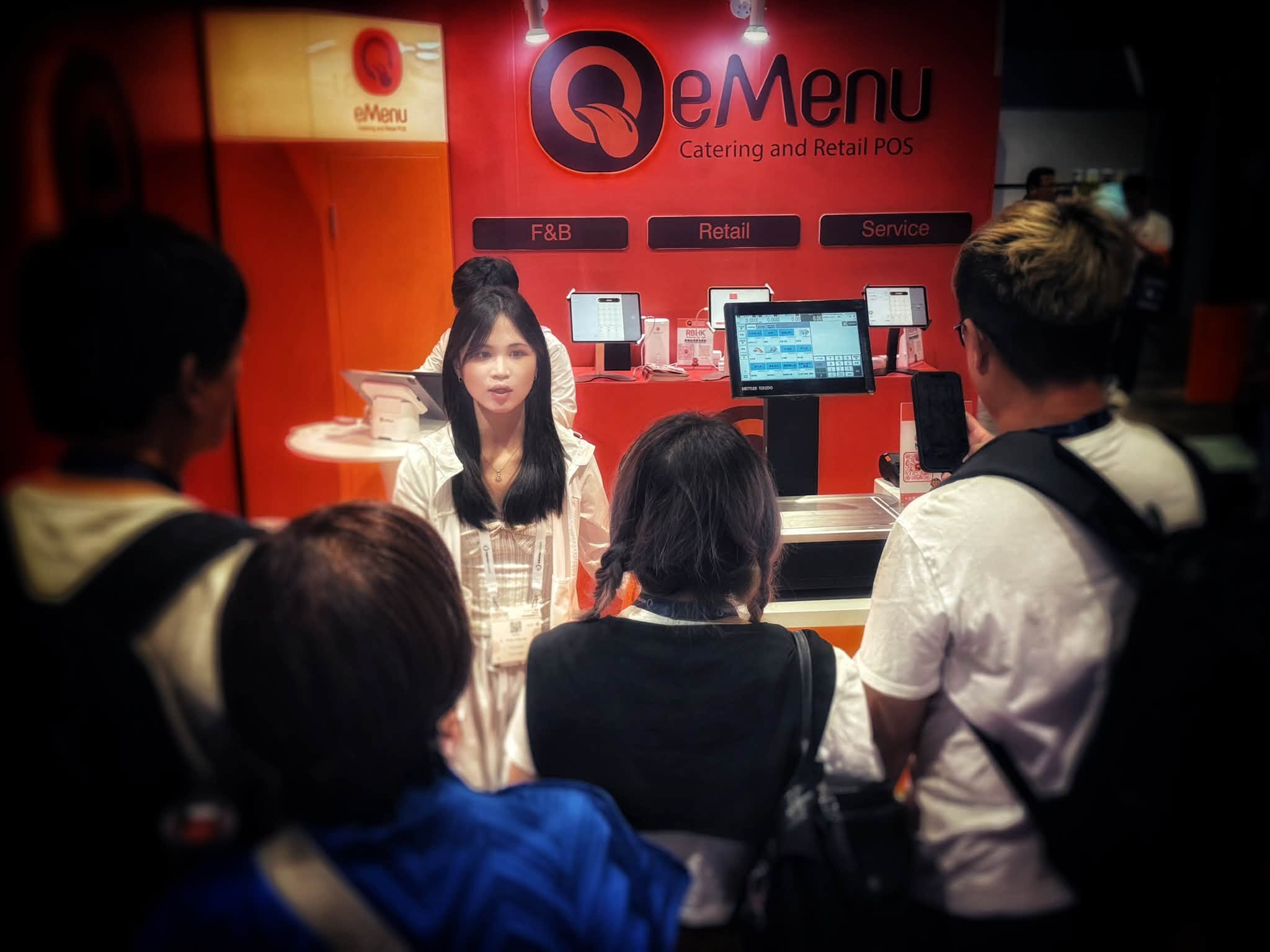
That is us, so read this section with appropriate suspicion. eMenu is a QR self-ordering and POS system built for restaurants, cafés, bars and beach venues in Thailand's tourist provinces. The one thing we do that most systems on this list do not is run the guest-facing digital menu in 12 languages including English, Chinese (Simplified and Traditional), Japanese, Thai, Vietnamese, Italian, Spanish, Korean, Portuguese, French and Russian, so a table of mixed nationalities each orders in their own language without a multilingual waiter. First-year packages are published: THB 18,999 (Easy Start — coffee shop, fast food, kiosk), 27,999 (Smart Power — shabu, restaurant, café, bar) and 45,999 (Ultimate Max — restaurant, seafood, beach bar, hotel), with a free trial and a 30-day money-back guarantee. The core POS runs on iPad; the guest menu opens in any phone browser. Our team is based in Krabi and Phuket and installs on site, typically going live in 3–5 days.
Reported results from our own customers (our data, not audited by anyone else): −30% operating cost at The Tonga, Khao Lak; −31% order errors at Johnny's Pizza; +18% repeat customers at Chill & Bliss Spa; −100% printed menu cost at Zarnish Food.
Where we are the wrong choice — plainly. We are not built for large multi-outlet chains, and we do not offer deep delivery-aggregator integration; if a big share of your revenue arrives through delivery platforms, pick one of the systems below that specialises in that. Franchise groups needing central purchasing, warehouse transfers and consolidated group accounting will outgrow us. And if you want to run your POS on cheap generic hardware rather than iPad, we are not your system.
FoodStory POS — the iPad line of LINE MAN Wongnai
FoodStory is operated by Wongnai Media Co., Ltd., which makes it the closest thing Thailand has to a default choice: the group's own site claims 60,000+ restaurants across all 77 provinces (their number, not independently audited). Its real advantage is ecosystem: native LINE MAN delivery orders drop straight into the kitchen, and a Sales Channel feature lets you set different prices and GP per delivery channel — a genuinely useful thing that cheaper systems make you do with a calculator. As published on their pricing page on 27 July 2026, the iPad line costs THB 1,590/month for quick service, 1,990 for full service and 2,290 for buffet (excl. VAT; annual equivalents 19,080 / 23,880 / 27,480). Hardware is Apple, and priced openly — an iPad 9 is THB 12,056, a Star M-pop printer-and-drawer THB 18,599. There is a 30-day free trial and 24-hour phone support. Watch out: printer counts are capped per package, so a busy kitchen with multiple stations gets pushed up a tier; and the price list image on their site was uploaded in June 2025, so confirm current pricing with sales.
klikit
klikit is the odd one out here, and it is important to understand why before comparing prices. It calls itself "the operating system for merchants" — its centre of gravity is consolidating orders and menus from many delivery platforms into one dashboard, with POS as one module inside its Core package rather than the product itself. Its own pages state 12,000+ merchants and 3M+ monthly orders, with local teams in seven countries including Thailand (their figures). If you run a cloud kitchen, several brands out of one kitchen, or a delivery-led operation drowning in tablets from different platforms, this is the category of product you want. Watch out: no package has a public price — Core, Omni and Advanced Inventory all say "Contact Us" and Grow is "Custom Pricing" — and pricing includes revenue share: +0.5–3% on payments processed and +2–5% on Webshop orders, with fine print stating klikit may charge fees on top of normal payment-gateway MDR. Their own site also states both "20+" and "50+" delivery platform integrations on different pages. For a pure dine-in restaurant with no delivery, most of what you would pay for goes unused.
Loyverse
Loyverse is the honest answer to "I have almost no budget." The core POS, the owner dashboard, the kitchen display and the customer display are free, with no branch limit, and it runs on both Android and iOS — including hardware you already own. The interface is available in Thai, one of 17 languages. For a single café, a market stall or an owner testing whether a POS helps at all, nothing else on this list competes at zero baht. Watch out: free has edges. By default you can only see the last 31 days of sales data — analysing last year's high season requires the Unlimited Sales History add-on at USD 9/month per store. Employee permissions and timecards cost USD 25/month per store, and purchase orders plus inventory valuation another USD 25/month per store; a real restaurant with staff and stock is closer to USD 50/month per store than free. Card-payment integrations listed are Shift4, SumUp, Tyro, Zettle and Yoco — no Thai acquirer and no PromptPay integration listed — and hardware is bought from third parties, with no on-site installation.
Ocha POS
Ocha is the pragmatic Thai workhorse, and it does two things unusually well. First, it explicitly works offline and can still issue a Thai tax invoice — the only system in this comparison whose own documentation states offline mode outright. Second, it handles the messy realities of Thai retail food: pricing by weight, deeply customisable menu options (topping, sweetness level — a bubble-tea shop's nightmare), a Host-Slave mode that syncs several iPads, tablets or Sunmi terminals into one report, and four levels of staff permission. Pricing is clear: THB 799/month for software you install on your own tablet (THB 8,900 for 12 months in-app), or hardware bundles from THB 17,990 to 30,990 including three months of software. There is a 14-day free trial. Watch out — two things. Ocha's brand and service are transferring to SCommerce (Thailand) Co., Ltd. effective 1 August 2026; the announcement says service continues as normal but says nothing about future pricing or features, which is an open risk. And Ocha's own help centre still publishes a limitations list saying it cannot take QR-code orders, cannot connect to delivery platforms, does not support dynamic QR payment, and cannot connect its membership system to outside software — yet Ocha itself published a Scan-to-Order setup guide in September 2025 and a ShopeePay/PromptPay auto-close guide in February 2026. Their two official sources contradict each other; get it in writing from sales before you buy.
Papaya
Papaya is a Bangkok company founded in 2022 that positions itself as an AI-driven restaurant operating system, and its strengths are aimed at operators who care about margins per plate. Two stand out. Payment coverage is the broadest here — its integrations page lists 18 methods including PromptPay QR, KBank, SCB, Krungsri, TrueMoney Wallet, ShopeePay, Alipay and WeChat Pay. And costing goes down to ingredient level: recipes, COGS, supplier management, stock counts, modifier-driven ingredient depletion and daily re-ordering suggestions, with invoice-scanning and central-kitchen forecasting on the top tier. Delivery arrives via Grab directly, Lalamove for your own riders, and Deliverect as a bridge to other aggregators. Published pricing is USD 49 / 89 / 179 per month per location, with 30-day free trial, no setup fee, and Thai plans including a free EDC terminal and printer. Watch out: that USD pricing is labelled indicative for international markets — the company says Thailand is quoted in baht, and we could not retrieve the baht figures (the region switch is script-driven), so ask for a THB quote. Billing is per outlet, Starter excludes delivery integrations, and the analytics people actually want are locked in the USD 179 tier.
Qashier
Qashier has the lowest published all-inclusive software price in this comparison: THB 7,990 per year for Essential, or 11,990 for Growth (both excl. 7% VAT). It sells its own all-in-one terminals — the QashierX1 at THB 14,999 and QashierXL at 22,999 — bundled into starter kits promoted at THB 10,900 / 15,900 / 21,900 that include twelve months of Growth software, first menu setup, training and delivery. It is a Singapore-licensed payment institution (MAS Major Payment Institution) claiming 25,000+ merchants across Southeast Asia, and it handles the F&B basics properly: table management, ingredient stock, QR ordering, dynamic PromptPay QR payment, and buffet timing. Watch out: the cheap tier has hard ceilings — Essential caps at 1,000 items and 500 CRM contacts with only basic promotions — and several things you may consider essential are paid extras: kitchen display THB 2,490/year, GrabFood integration 1,090/year, buffet timing +2,990/year, extra device accounts +2,490/year each. Their site also shows Growth at both 11,990 and "normally 9,990" on the same page. And the app is distributed through Google Play with 8-inch-plus Android tablets recommended; no iOS version is listed — if you are committed to iPad, this is not your system.
Silom POS
Silom POS is the value play for Thai owners who already run their business inside LINE and Grab. It publishes a full price ladder — THB 490/month (Starter+), 990 (Smart+), 1,990 (PRO) and 2,990 (PRO+), or 4,900 / 9,900 / 19,900 / 29,900 per year, excluding VAT — which makes it the cheapest paid entry point here. It is an Official Grab Partner with direct GrabFood order flow, and its LINE integration is genuinely useful in Thailand: CRM through your LINE Official Account plus real-time sales alerts pushed to LINE. It also does BOM ingredient costing, Thai tax invoices, barcode labels and connected weighing scales, and runs on both iOS and Android. Watch out: the software is licensed only with hardware the company sells, so you cannot bring your own iPad — sets run THB 21,900–23,400. Starter+ is thin: one device, 2,500 items, no QR ordering, no staff ordering app. Kitchen display and buffet mode sit at the PRO end, and their own site is inconsistent about whether buffet mode exists at all. On-site service is billed at THB 2,900 per three-hour visit, which matters if your shop is far from Bangkok.
StoreHub
StoreHub is a Malaysian all-in-one platform, claiming 18,000+ businesses across Southeast Asia, and it is the strongest choice on this list for businesses that are part restaurant and part shop. Its Thai pricing page publishes THB 990 / 1,999 / 4,800 per month plus a custom Enterprise tier. Three things stand out: it states plainly that the POS keeps working without internet; it syncs stock and orders with Shopee, Lazada, TikTok Shop and Shopify, which no other system here does; and it runs its own delivery brand, Beep, with its own rider network, pitched as far cheaper than the 25–35% commissions of the big platforms. Multi-branch central management, deep stock control with warehouse transfers, built-in loyalty and automated SMS campaigns all sit from the middle tier up. Watch out: hardware pricing is not published anywhere — the hardware page lists bundles with no numbers at all, so your real entry cost is unknown until you talk to sales. Their own two pricing URLs disagree, one showing THB 990 and the other USD 39 for the same Starter tier. Starter is basic stock and basic reporting only, and the discount structure pushes hard toward 24- and 36-month commitments.
SUPER restaurantOS (formerly SUPER POS)
Worth knowing before you search for it: the brand has been renamed. SUPER POS is now SUPER restaurantOS, the old supercoconut.co domain redirects to super.co.th, and the company is still Super Coconut, in Bangkok. Its differentiator is genuine and unusual in this price bracket: alongside POS, QR ordering, CRM loyalty, real-time inventory and an AI dashboard, it includes an HR module that does staff scheduling and payroll, and an accounting module — things every other system on this list expects you to buy separately. It supports the full range of Thai formats, from cafés and bars to franchises, buffets and weight-priced shops, and promises support replies within five minutes, 24 hours a day. Its site claims 1,000+ restaurants (a 2025 press release said 300+ brands). Watch out: pricing is close to opaque. The only public figure anywhere on the site is "from THB 14,900" in a homepage FAQ, with no indication whether that is monthly, annual or one-time, no package table, and no hardware prices. Delivery-platform integration is not documented publicly at all — not stated as absent, simply not mentioned. The site is also mid-rebrand, with three different contact email addresses and both old and new social accounts live.
Wongnai POS — the Android line of LINE MAN Wongnai
Same company as FoodStory, different hardware philosophy. Wongnai POS is the cheapest entrance to the LINE MAN ecosystem: a terminal from THB 8,900 (the group's homepage says machines start at THB 10,000, one of several places where their own numbers differ) and software advertised from THB 14 per day. LINE MAN orders arrive automatically and print to the kitchen, your shop profile syncs to the Wongnai platform in front of what the company describes as ten million diners, there is a dual-screen model that shows promotions to the customer, a free manager app, and daily sales summaries pushed to LINE. A new single-screen model with a built-in 80mm printer launched in July 2026. Support is 24 hours. Watch out: the company itself says the Android line is for shops with one branch, or fewer than five, and its own comparison table gives the iPad line the inventory management, staff ordering app, EDC integration and advanced CRM. There is no buffet package on Android at all — if you run หมูกระทะ or shabu, you are buying the iPad line. Note also that the group's own brochure lists stock management under the Android tier while its comparison table does not; ask sales to confirm in writing.
Which one is right for your restaurant?
Where eMenu fits — and where it does not
eMenu Thailand is built for one situation: an independent restaurant, café, bar or beach venue in a tourist province — Krabi, Phuket, Phang Nga, Surat Thani — where one table can hold four nationalities and the owner wants a real person on the phone, not a ticket number, when something breaks mid-service. The guest menu runs in 12 languages, so no one waits for a multilingual waiter, and our team installs on site, usually live in 3–5 days. First-year packages are published at THB 18,999 / 27,999 / 45,999, excluding 7% VAT, sold as an annual subscription — there is no one-time purchase.
It is the wrong choice in three cases. If most of your revenue arrives through LINE MAN or Grab, FoodStory and klikit integrate more deeply. If you also sell retail products or run much of your business through Shopee, Lazada or TikTok, StoreHub is built for that and we are not. If you need the cheapest possible start, Loyverse is free and we are not.
Frequently asked questions
What is the best restaurant POS system in Thailand? There is no single best one, and any vendor who says otherwise is selling. The right answer depends on three things: how many outlets you run, what share of your sales comes through delivery platforms, and whether your guests read Thai. For established Thai restaurants and buffet shops where LINE MAN delivery matters, FoodStory / Wongnai POS is the default. For delivery-led and multi-brand operators, klikit or Papaya. For food-and-retail or multi-outlet businesses, StoreHub. For restaurants in tourist provinces serving international guests, a multilingual QR menu system such as eMenu Thailand. For the smallest shops, Loyverse's free tier, Qashier Essential or Silom POS Starter+.
How much does a restaurant POS system cost in Thailand in 2026? Published software prices range from free to about THB 4,800 per month. As of 27 July 2026: Loyverse core POS is free (add-ons USD 9–25 per month per store); Silom POS starts at THB 490/month; Ocha POS is THB 799/month; StoreHub starts at THB 990/month; Qashier is THB 7,990 per year; FoodStory's iPad line is THB 1,590–2,290/month; Papaya lists USD 49–179 per month per location; eMenu sells first-year packages at THB 18,999 / 27,999 / 45,999. klikit does not publish prices and adds 0.5–3% on payments processed; SUPER restaurantOS publishes only "from THB 14,900" without stating the billing period. Most prices exclude 7% VAT, and hardware is usually extra — StoreHub and Loyverse do not publish hardware prices at all, while FoodStory, Qashier, Silom POS and Ocha do.
Which POS systems in Thailand support multiple languages for tourist areas? Two different things get confused here. Staff-facing language is whether your cashier screen is in Thai — most systems on this list have that, and Loyverse offers 17 interface languages. Guest-facing language is whether the customer can read the menu and order in their own language, which is what actually matters in Phuket, Krabi, Pattaya or Samui. Very few local systems address it: eMenu Thailand runs the guest QR menu in 12 languages including English, Chinese (Simplified and Traditional), Japanese, Thai, Vietnamese, Italian, Spanish, Korean, Portuguese, French and Russian, and Ocha's app interface is English and Thai. If a large share of your guests are Chinese or Russian, ask any vendor to show you the guest menu in that language on a phone before you sign anything.
Can I add a QR menu without replacing my POS? Yes, and several systems here include QR ordering as an add-on to what you already run — Qashier, Silom POS (Smart+ and above), StoreHub and Papaya all offer it, and Ocha released a Scan-to-Order feature in September 2025. The trade-off is that a QR menu bolted onto a separate POS often means staff re-typing orders into the till, which reintroduces exactly the mistakes the QR menu was supposed to remove. Before buying a standalone QR product, ask one blunt question: does the order land in the POS and print to the kitchen by itself, or does someone have to type it again?
The bottom line
Thailand does not have a best restaurant POS — it has clusters. LINE MAN Wongnai owns the mainstream Thai restaurant and buffet market through FoodStory and Wongnai POS. Qashier, Silom POS and Loyverse fight over the price-sensitive end. StoreHub owns retail-plus-food and online sellers. klikit and Papaya own delivery-led and margin-obsessed operators. SUPER restaurantOS is chasing groups that want HR and accounting in the same box. And there is a real gap, which is where we live: independent restaurants in tourist provinces whose guests do not read Thai and whose owners need someone who can physically walk into the shop.
Whichever direction you lean, do these three things before paying anyone. Ask for the price in baht, in writing, including VAT and hardware. Ask what happens to the POS when the internet drops. And ask what a Saturday-night emergency looks like — who answers, in what language, and how fast. The answers to those three questions predict your satisfaction better than any feature list, including this one.